Showing posts with label culture. Show all posts

Tuesday, May 22, 2012

Baseball; not as boring as you might think


Before arriving at Koshien stadium last Sunday I was sceptical to say the least about spending four hours watching baseball. Having only ever watched (American) baseball on TV before I, like many before me, had labelled the game tedious and boring. How can you have a game that lasts for so long only to finish 1-0, I thought. With these doubts hanging over me I gave the live version of the game a try during Golden week. As it turned out the game finished 2-1, hardly a high scoring contest, but boring? No chance. Baseball in Japan is a different prospect from the American game it draws  its inspiration from. It could have finished 0-0 for all I cared, for baseball on this side of the globe is as much about the crowd as the game itself, and the crowds in Osaka are quite something.

Irrespective of my preconceptions of baseball I had actually wanted to attend a game in Japan for a while. As much as I can tell it’s the national sport and having bumped into Hanshin Tigers fans at the central Umeda station with great regularity I’ve been able to get an idea of just how passionate Japanese baseball fans are. To add to the draw, the Hanshin Tigers home is Koshien stadium, which is to Japanese baseball what Wembley is to English football. It’s the sort of place that Japanese children dream of one day playing and dates back as long ago as 1924. After a brief hiatus following the Great Hanshin Earthquake, capacity crowds of nearly 50,000 now regularly attend games. Last week’s game was no exception and I formed part of a sell-out crowd to see the grudge match between the Tigers and the Yomiuri Giants from Tokyo.

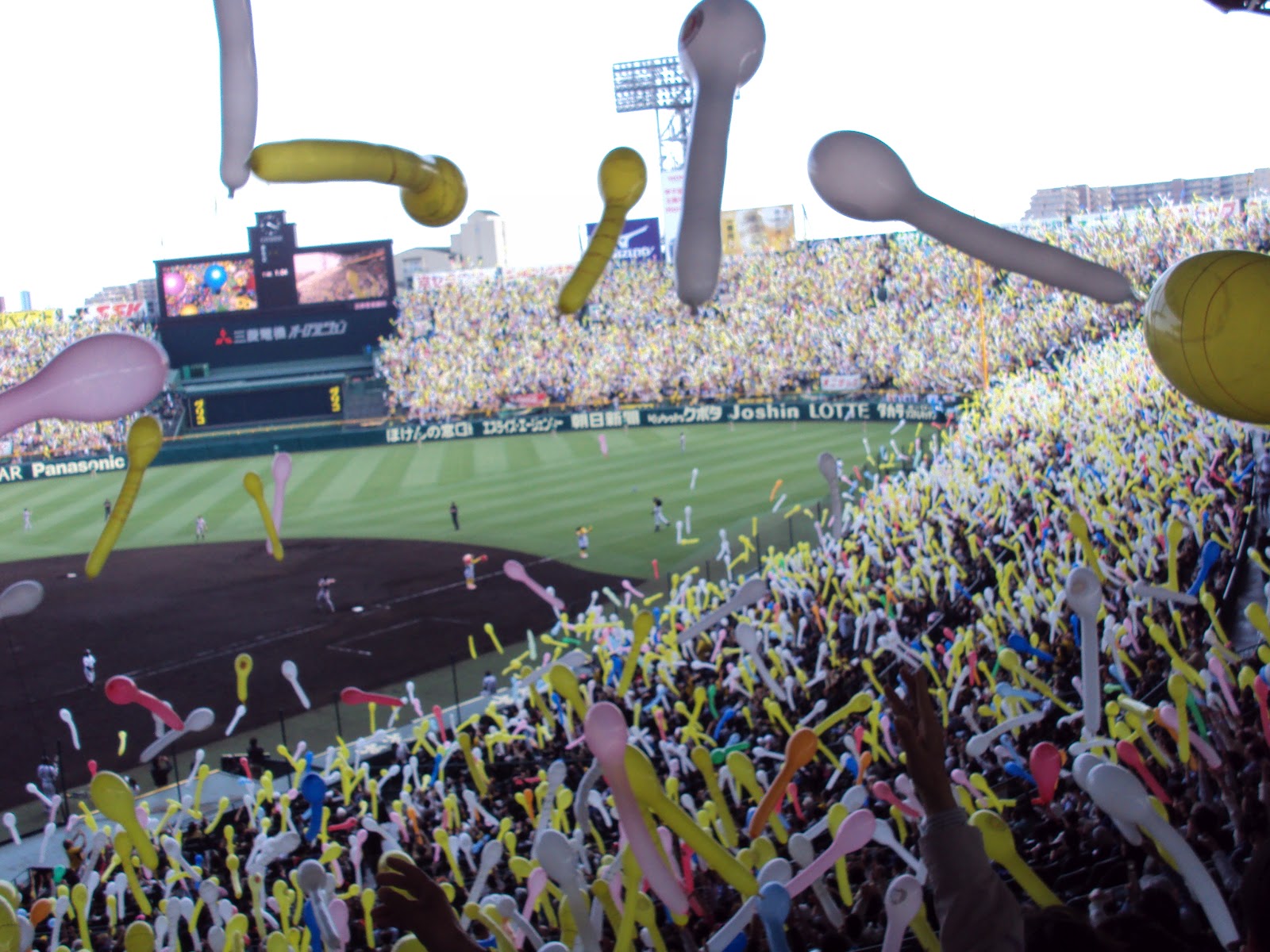

The atmosphere around the stadium before the game reminded me a lot of the first time I ever watched Arsenal play football at Highbury. Nothing beats the feeling of anticipation that comes from a sell-out crowd enjoying a sunny day before a match, whatever the sport, and at Koshien there is an incredible buzz. The stadium is surrounded by stalls selling all manner of memorabilia and the smell of the food from the various food stands is intoxicating. Entering the stadium is a breeze and the only hold-up comes from having to decant any cans or bottles of beer into cups or plastics, a small price to pay for bringing in your own cheap booze, a fact seized upon by a large proportion of the crowd.

For those who don't really know the rules of baseball it can take a little while to get into the game itself but at Koshien this is not entirely down to a lack of baseball knowledge. The real spectacle for a newbie is the crowd. Virtually every crowd member arrives with mini plastic baseball bats to hand ready to bang together to the tune of the brass instrumentalists who play well-rehearsed chants prepared for each individual player. A merry band of ‘crowd conductors’ then lead the crowd of nearly 50,000 to sing and bang together for virtually the entirety of the four hour game. It's quite something to watch. 

One of the best parts of the day comes at the end of the seventh innings when the opportunity to witness one of the newer traditions of Koshein takes place. Having purchased some balloons at a memorabilia stall before the game, I joined in with 50,000 others and let them deflate into the sky in unison. Such a description hardly does justice to just how brilliant this is to watch (this video should give a better idea). Its only right that a traditional stadium has certain traditions and though this one may not date back quite as far as 1924 it will no doubt continue for a good while yet.

Baseball in Japan really surprised me. It was far from the bore fest I had expected and even the game itself is quite entertaining. Like most things in Japan it's the unique Japaneseness of the event that makes it that little bit more special though. Next stop on the Japan sport trail for me is football. The crowd will have to be something special to beat the fans down at Koshien though.

Tuesday, March 20, 2012

FARPLANE 2012 - Just another night in Osaka...


OK, so this wasn’t just another night in Osaka, this was the annual Farplane get together in Osaka which put simply is one fucking crazy night!

Hosted by the Farplane store in American Village, the annual event attracts an eclectic collection of the most eccentric individuals in Osaka who come together for a night of diverse music, dancing, and stage entertainment. I heard about Farplane through a friend of a friend and after watching a video of last year’s event I was a little sceptical about getting a ticket, the truth is this isn’t the kind of night out I’m used to going to, I’ve lived in rural England most of my life after all. But in the end I parted with 3000 yen and got my hands on an advanced ticket.


In a room full of what most people would describe as being utterly overdressed I was predictably underdressed wearing jeans and a shirt, but then, it’s not often you can share a room with a man covered head to toe in gold paint, wearing nothing but a strap on penis and yet still feel like the odd one out.


The party started at 4 in the afternoon and went through to 11pm with stage entertainment throughout the day and night hosting everything from DJ sets and dance acts to performers being suspended above ground from hooks attached to their backs and necks. The latter was actually a pretty weird thing to witness but most people around the stage seemed to enjoy it and even those being suspended seemed reasonably happy about the whole thing so who am I to criticise. This was just one part of a long night of diverse entertainment though and if there was a performance you didn’t like you could bet there would be something along before long that you did. It was a night like no other and something few outsiders get the chance to experience. If I’m still in Osaka this time next year I’ll make sure I’m at the next Farplane, only next time I’ll make sure I have a decent outfit to wear!

Wednesday, March 14, 2012

Happy White Day!

That’s right, today is White Day, apparently not a day for celebrating the positive influence of White people in Asia, but instead a day for the boys of Japan, South Korea, China and Taiwan to give girls chocolates (providing of course said girls gave said boys something decent on Valentine’s day). 

Here is a picture of a monkey with a sign promoting White Day. Something about it says politically incorrect to me.


Sunday, February 12, 2012

Fake Beer?!


Following in the success of imported beers such as Mexico’s Corona, the Japanese beer Asahi has become increasingly popular in the UK. In the same way you no longer have to go to an Italian restaurant to drink a Peroni, you no longer have to go to Yo! Sushi to get your hands on an Asahi. Having enjoyed this light beer on the few occasions I’ve tried it, I was looking forward to sampling what else the Japanese beer market could offer me now that I live here. One thing I wasn’t expecting was the popularity not of Asahi but of so called ‘fake beers’. “Fake beer”?! I hear you say. Yes, fake beer does exist here in Japan, indeed, it flourishes.

Upon greater research it becomes clear that there are in fact three categories of ‘beer’ in Japan, each owing its existence to specific tax clasifications. Like most things in Japan these laws are beautifully illogical.

Regular beer – the Asahi’s of this world – must contain at least 67% malt and are subsequently taxed at the highest rate


Happoshu (literally meaning ‘Sparkling Spirits’) must contain less than 25% malt. These are taxed at a slightly lower rate

And finally there are the ‘Third Category’ beers, containing no malt at all. Exactly what is used in the brewing process instead of malt is changeable, but common substitutes include corn, peas, and soy. Needless to say these beers attract a far lower tax rate and a greatly reduced price for consumers.

Initially I wasn't put off by the concept of ‘fake beer’, in fact I was curious to try as many of these peculiar concoctions as possible (much to the disgust of my girlfriend’s Japanese father). Unfortunately as expected fake beer tastes a lot like you might expect fake beer to taste; shitty. A bit like beer but not quite the same. It’s a rare thing to find anyone praising cheap English lager, the Fosters, Carlings and Carlsbergs of this world, but you’d struggle to find anyone in Japan who wouldn’t give up a Suntory ‘Rich Malt’ in return for its British equivalent.

Just as British supermarkets continue to sell Fosters by the shipload day after day though, fake beer continues to be hugely popular here in Japan, as is often the case, it is not quality that is dictating consumer choice, but price. Given that the average can of third category beer is up to a third cheaper than a regular can this is hardly surprising. Despite its questionable taste and renowned ability to cause disproportionately vicious hangovers, it’s hard to argue with a saving of more than 30%.

The future looks disappointingly predictable. The big four Japanese breweries expect demand to continue growing, indeed a report in Japan Today stated that all four were expecting double digit sales growth for Third Category Beers. It would appear then that as a new inhabitant of Japan I have little choice regarding my future drinking habits. Either get a decent job or acquire a taste for fake beer.

Wednesday, February 8, 2012

The Universal Language of Good Manners


On my plane from Heathrow to Osaka I watched Lost in Translation, it scared the shit out of me. Having spent the previous six months telling anyone who’d listen how much I was looking forward to moving to Japan I was faced with the sudden realisation that I was in fact, moving to Japan. I saw Bill Murray’s character, Bob Harris, struggle to come to terms with the unique culture he was faced with upon arrival in Tokyo; the size of the city, the number of people, the weird technological advances and the idiosyncrasies of the cities inhabitants. After a little over a week spent living in Osaka, it is another of the great Japanese clichés that has struck me most. An aspect of Japanese culture that marks the country apart from all other modern countries I can think of – the impeccable manners of the Japanese people.

Of course it is an almost universally accepted fact that the Japanese are in general, helpful and polite, but I hadn’t counted on just how helpful and polite they would be. Perhaps this comes down to having spent the past 26 years of my life living in the UK, a nation that ostensibly prides itself on service without a smile. The contrasts are universal. Take the ‘convenience store experience’ for example.

In general the convenience store workers of Britain give the impression that they would rather be just about anywhere else. The interviews must be a doddle, if you can come across as even slightly enthusiastic about a career selling fags and booze you surely stand an excellent chance of employment. The trouble is, no-one really wants to work in these places. In general, the average British customer doesn’t tend to have a problem with this attitude though; we accept that jobs such as working in a convenience store, or flipping burgers at McDonalds, are menial jobs – beneath those who frequent such establishments. And thus an unwritten contract has emerged between customer and worker that makes it acceptable for workers to be morose and unhelpful, while in return customers can feel no remorse in behaving like spoilt children, everyone’s happy, right?

Much of this decline in customer service follows the disappearance of the independently owned ‘corner shop’ and the emergence of the scaled-down supermarket. Having devastated countless local businesses, unable to keep up in the age of rock-bottom prices and loss-leader policies, Tesco et al have moved into the very high-streets they destroyed, installing mini versions of themselves in one last effort to rob town centres of any remaining diversity they might have. Where once we could rely on a friendly face and a smile when picking up the paper or buying a loaf of bread, we are now faced with a drone army of supermarket workers, destined to disappoint in an era of short-term contracts, low wages, and virtually no employment rights. Indeed, in this era of mini supermarket style convenience store, workers have almost nothing to gain by providing good customer service.

If bad service at convenience stores really is the result of ownership falling into fewer hands, or the demise of independently owned corner shops why then is it that the ‘convenience store experience’ in Japan is so different? Let’s start with the important points about the Japanese convenience store, or ‘conveenie’ as they are more widely known. They are brilliant.

Located on virtually every corner of every street in major Japanese cities they have everything you could ask of such a store... and more. Along with the usual selection of crisps, chocolates and soft drinks, they sell a dizzying assortment of hot and cold snacks ranging from traditional savoury rice balls wrapped in seaweed, to fried chicken and cheese burgers. The hot selection is the real highlight. Korokke – a breaded potato and pork snack – is a particular favourite. It’s not just the food that impresses though, it’s the small additions that set the Japanese ‘conveenie’ apart from the British ‘mini-supermarket’. Virtually every ‘conveenie’ for example has a toilet which means that rather than following in the British tradition of pissing down a back ally, late night revellers can instead relieve themselves in comfort before picking up a beer for the road.

Though unquestionably impressive in their material offerings, the most impressive aspect of the ‘Convenience store experience’ in Japan is without doubt the staff. The positive attitude of those on the payroll of the Seven Elevens, Family Marts, Lawson’s, and similar stores throughout Japan is infectious. Upon entering any one of these stores you will be greeted without fail with a beaming smile and a cry of “irashaimase” – welcome. It should be noted here that my Japanese speaking ability is limited to say the least so the majority of what is said to me in the process of a transaction is meaningless. Perhaps though it is better this way, for all I know they could be ridiculing my dress sense or insulting my family, the fact it is said with a smile makes the content almost meaningless, however.

Maybe I am being a little too generous here though, perhaps the Japanese attitude to customer service is normal and it is the British attitude that is abnormal. I think this does Japan, as a nation, a great disservice, however. While modern countries around the world have lost all sense of community in an ever increasing transition towards universal selfishness, Japan, it seems, has stayed true to its traditions of mutual respect and good manners. I have only been here for a little over a week so my opinions will doubtless change over time, for now though it is not the climate, nor the technology, or any other of the major differences that mark Japan apart from Britain that make me so positive about living in here in the future. It is instead the simple good manners of the lowly convenience store workers of Osaka and beyond.